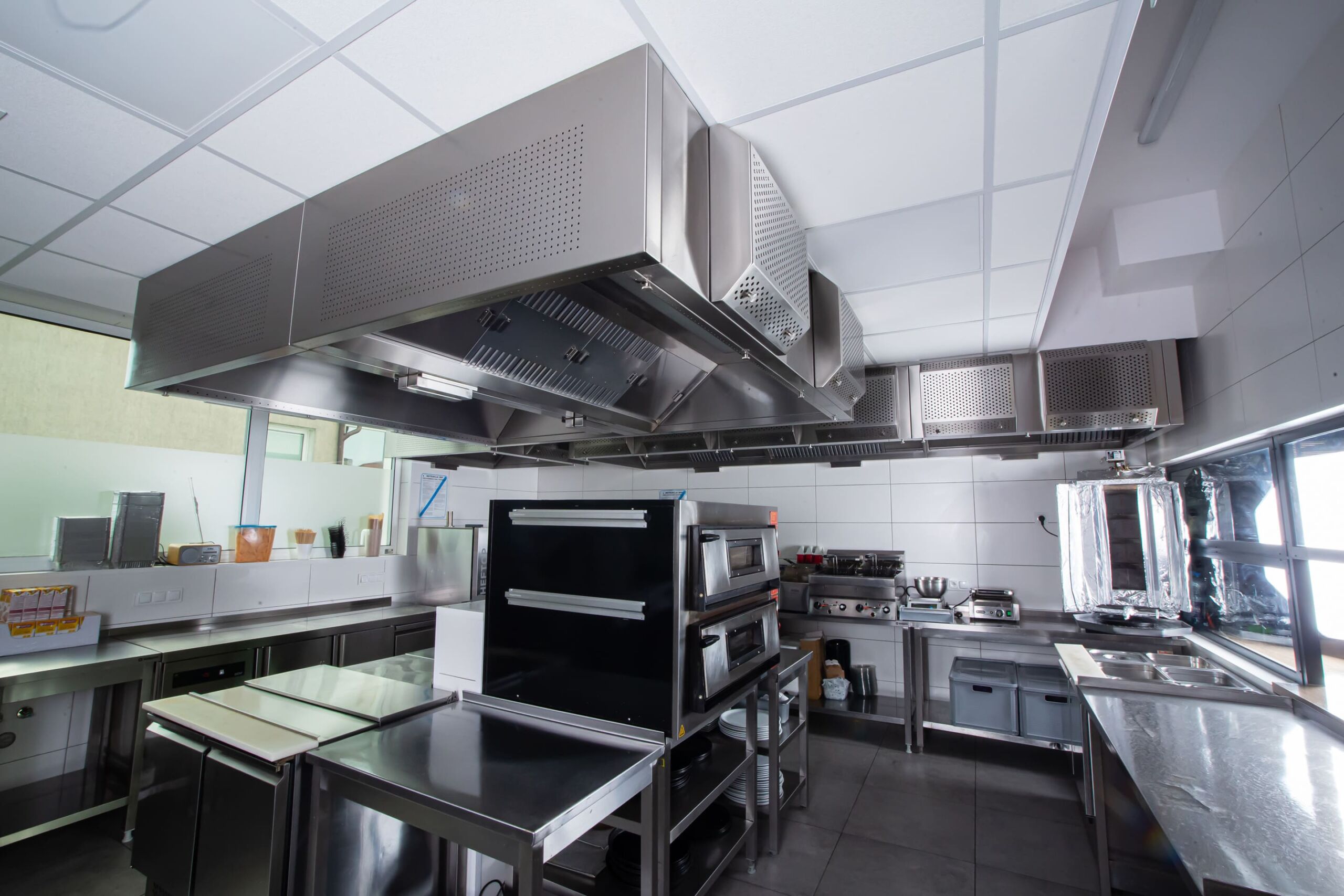
A hood is sized to the appliances underneath it, not to the floor area of the kitchen. Too small, and it won’t capture the fumes, so grease ends up on the ceiling. Oversized, and it extracts heated air – and with it, money spent on heating. Below is the order we follow ourselves when we receive a kitchen layout.
The reference point is the standard PN-EN 16282-1 and the German guideline VDI 2052, on which the standard is largely based.
1. What will stand under the hood
We start with a list of appliances: type, power in kW and energy source (gas or electric). This is the most important information, because appliances with the same power release very different amounts of heat and fumes. A griddle or a fryer loads the hood much more than a boiling kettle of the same power. That is why swapping one appliance for another during the project also changes the hood selection.
2. Grease or steam
Above appliances that produce grease (frying, grilling, roasting), a hood with grease filters is installed. Above dishwashers and appliances that mainly release steam and hot air, a condensation hood is used – it condenses the moisture before it reaches the duct.
3. Against the wall or over an island
An island hood draws air in from all sides, so it needs more exhaust than a wall-mounted hood over the same appliances. The EN 16282-1 calculation shows this directly: a factor of 0.63 applies to appliances against a wall and 1.0 to free-standing ones. If the kitchen layout allows it, grouping hot appliances in a block against the wall reduces the required airflow.
4. Hood dimensions
The hood must overhang the appliances on every open side, so that rising fumes go into the canopy, not past it. The minimum overhang is given in the standard. This matters most in front of appliances with doors, such as a combi steamer: when the door opens, a cloud of steam comes out, so the hood above it must be deeper.
5. How much air
At the concept stage, an estimate based on the kitchen floor area is enough. EN 16282-1 gives approx. 90 m³/h per m² of floor for the kitchen as a whole and approx. 120 m³/h where frying, grilling, roasting or dishwashing takes place.
The order requires an exact calculation. The standard describes a method that takes into account:
- the power and type of each appliance,
- the mounting height of the hood above the appliances,
- the dimensions of the appliances and the mounting position (wall or island),
- the fact that not all appliances run at once (simultaneity factor),
- how air is supplied to the kitchen (see below).
The standard also gives the capture velocity the hood should achieve: 0.15 m/s for light duty, 0.225 m/s for medium duty and 0.3 m/s for heavy duty.
The kitchen should be kept at a slight negative pressure relative to adjacent rooms, so that odours do not escape. Exhaust is therefore slightly higher than supply, but the difference should not exceed 10%. The kitchen temperature should stay between 18 and 26°C.
6. Where will the fresh air come from?
Every cubic metre extracted by the hood has to come back into the kitchen. If the supply air is poorly designed, it enters the zone under the hood at high velocity, disperses the fumes and the hood loses efficiency. Low-velocity, evenly distributed supply air works well.
Two solutions allow you to extract less air with the same efficiency:
- Air curtain in the hood. In KEMS® hoods with the JETstream™ system (OCPA, OPPA), part of the supply air goes to nozzles in the canopy. The jet from the nozzles keeps the fumes inside the hood and directs them to the filters, which allows exhaust to be reduced by up to 20%. The system complies with the VDI 2052 recommendations.
- Supply air built into the hood. In the OCPAN and OPPAN versions, fresh air flows from diffusers in the hood straight to the chef’s station, at low velocity, in three directions and without mixing with the fumes.
Finally: filters and commissioning
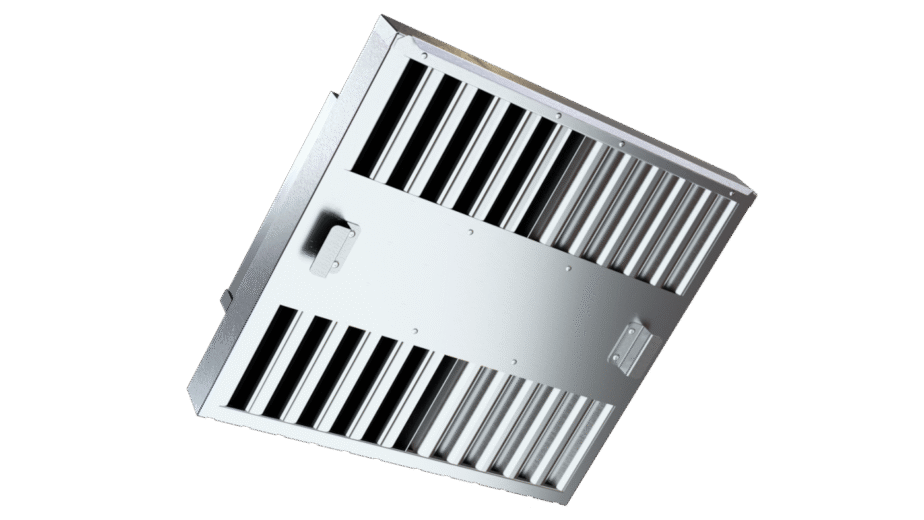
Filters determine how much grease reaches the ducts, and therefore how often they need cleaning and how high the fire risk is. We describe the differences between filters in a separate article: Multicyclone or baffle filter.
During commissioning, the airflow of each hood has to be measured and adjusted. Our hoods have measuring ports in the chambers for this, so the installer can take measurements without dismantling the hood.
Want us to check your project? Send the kitchen layout and a list of appliances using the form. We will prepare the hood selection and airflow calculations free of charge.