During inspections of commercial kitchens we keep seeing the same picture: ventilation ducts that, after a few months of operation, are literally coated with a layer of grease. Such a duct is a double problem. It has to be cleaned, and until someone does, it is fuel waiting for a spark from the kitchen.
How much grease ends up in the duct depends first of all on the filter in the hood. We explain how the two most common filter types differ and what the tests of our filters showed.
How a baffle filter works
A baffle (labyrinth) filter is a row of bent metal plates. The air changes direction several times, and heavier grease droplets cannot follow it and settle on the baffles. It is a simple and inexpensive design that handles large droplets well. Fine particles are another matter: they travel with the air into the duct.
How a multicyclone filter works
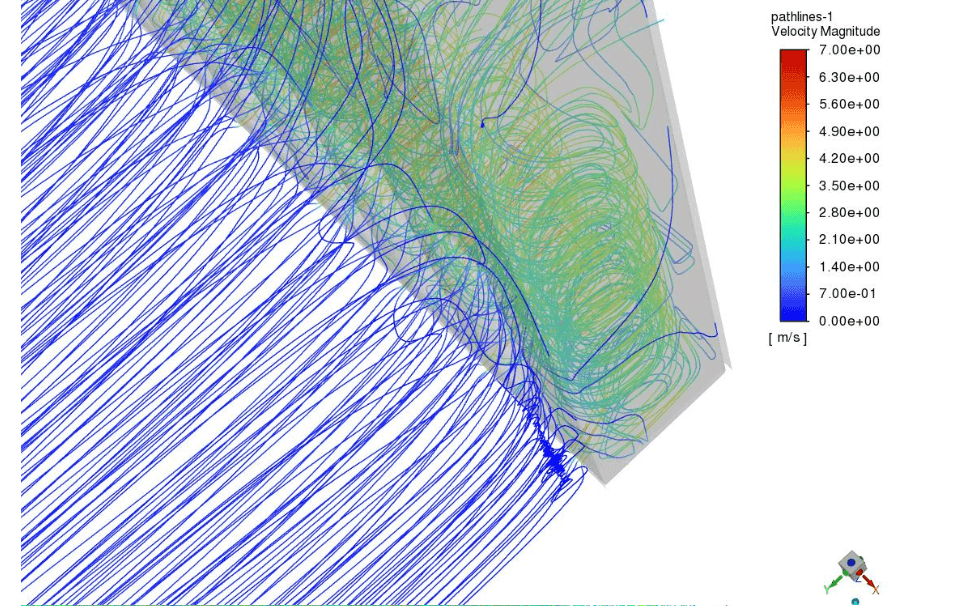
In a multicyclone filter the air doesn’t just turn – it enters a series of vortices. Grease particles in the spinning stream have too much inertia to follow its curve. Centrifugal force throws them against the walls of the filter channels, where they are retained.
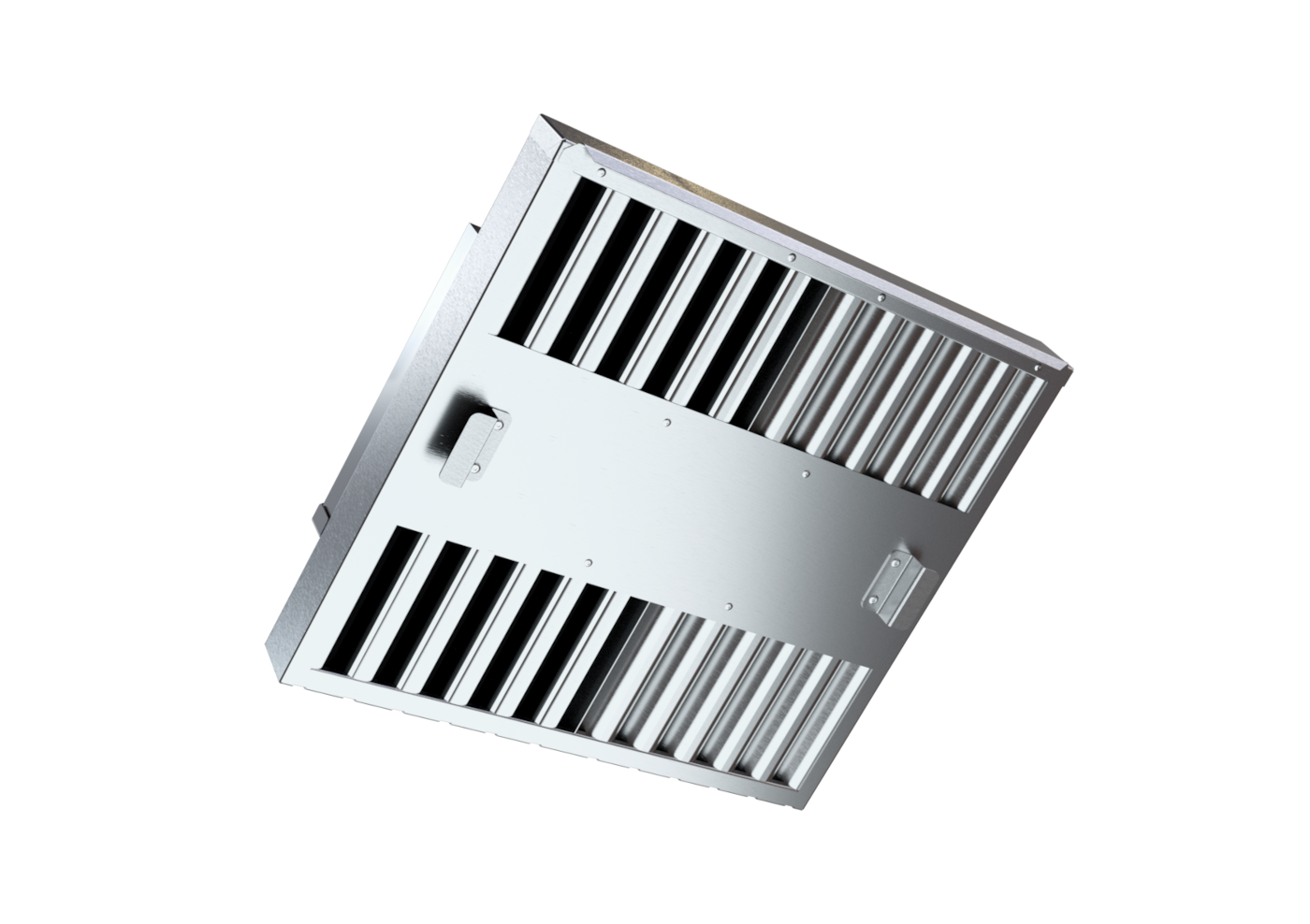
The filters in NOVA CVS hoods are installed at an angle. Retained grease does not collect in the filter; it drains by gravity into a gutter and a collection tank. This matters for safety: no grease that could ignite builds up in the filter.
We also verified with a flow simulation (CFD) that a vortex really forms in the filter. It was carried out by MESco in Ansys Fluent, on a computational mesh of about 60 million elements. The calculated efficiencies matched earlier laboratory measurements.
How filter efficiency is tested
A label saying “95% efficiency” means nothing on its own. Efficiency depends on particle size and on the airflow through the filter. That is why a reliable test reports it as a curve across particle diameters.
This is how filters are tested under the German guideline VDI 2052. An oil aerosol is fed to the filter, and particles are counted by size upstream and downstream. The result is summarised by the value d50: the particle diameter the filter retains at 50%. The smaller the d50, the finer the grease the filter captures.
What the tests of our filters showed
Our filters were tested by the DMT laboratory (TÜV NORD Group) in Essen, to VDI 2052-1, in two versions: the multicyclone filter alone and with a second stage, i.e. a mesh filter. Key findings:
The filter captures fine grease. At nominal airflow, particles from approx. 5–6 µm were retained completely. With the second filtration stage, half of the particles were retained already at diameters below 2 µm.
Pressure drop barely rises. After two hours of continuous grease aerosol loading, the filter’s pressure drop rose by just a few pascals. The filter does not clog, so the hood extracts the same amount of air right after washing and just before the next wash.
A cyclone filter needs airflow. Below nominal airflow, efficiency was noticeably lower. A vortex needs velocity, so oversizing the hood “just in case” makes filtration worse. One more reason to calculate the airflow rather than guess it (more in the article on hood selection).
Fire safety
The European standard EN 16282-6 checks, among other things, whether the filter stops flames. The filter is exposed to fire for one minute, and no flame may appear on the other side. Our set (multicyclone filter + mesh filter) passed this test at the TÜV NORD laboratory in Essen in February 2026 and was classified EN 16282-6-F-1, with no damage to the filter.
The filters are made entirely of 1 mm stainless steel 1.4301 (AISI 304) and can be washed in any commercial dishwasher.
Clean ducts mean a clean air handling unit
Grease that gets through the filter doesn’t stop in the duct. It travels on to the air handling unit and settles on the heat recovery exchanger. Replacing a greasy exchanger is very expensive, and cleaning it means shutting down the ventilation. Good filtration in the hood therefore protects the whole system, not just the duct above the kitchen.
What no grease filter can do
Even our filter with a second filtration stage retained only around 10–15% of particles smaller than approx. 1 µm in the tests. And no mechanical filter removes odours. Where this matters (a kitchen in a residential building, an outlet close to windows, heat recovery), a second stage is used: a UV-C chamber.
UV-C radiation breaks down grease molecules, and oxygen in the air forms ozone, which oxidises organic and odour compounds. The end products are mainly water and carbon dioxide. We use UV-C chambers from the Hungarian manufacturer R-FILTER, for which we are the exclusive distributor. They are certified as compliant with EN 16282-8 issued by DMT. The certificate also covers safety requirements: ozone concentration at the outlet, radiation shielding and switching off the lamps when the service door is opened.
Thanks to the modular design, a UV-C chamber can be added later to an existing system without replacing the hood.
In short
A filter is not defined by a single percentage, but by its efficiency curve from VDI 2052 tests and its fire class under EN 16282-6. A multicyclone filter captures fine grease, does not clog and drains grease into a tank. Before buying a hood, ask the manufacturer for test reports, not just the catalogue sheet.
We share the test reports of our filters with customers at the quotation stage: contact us.